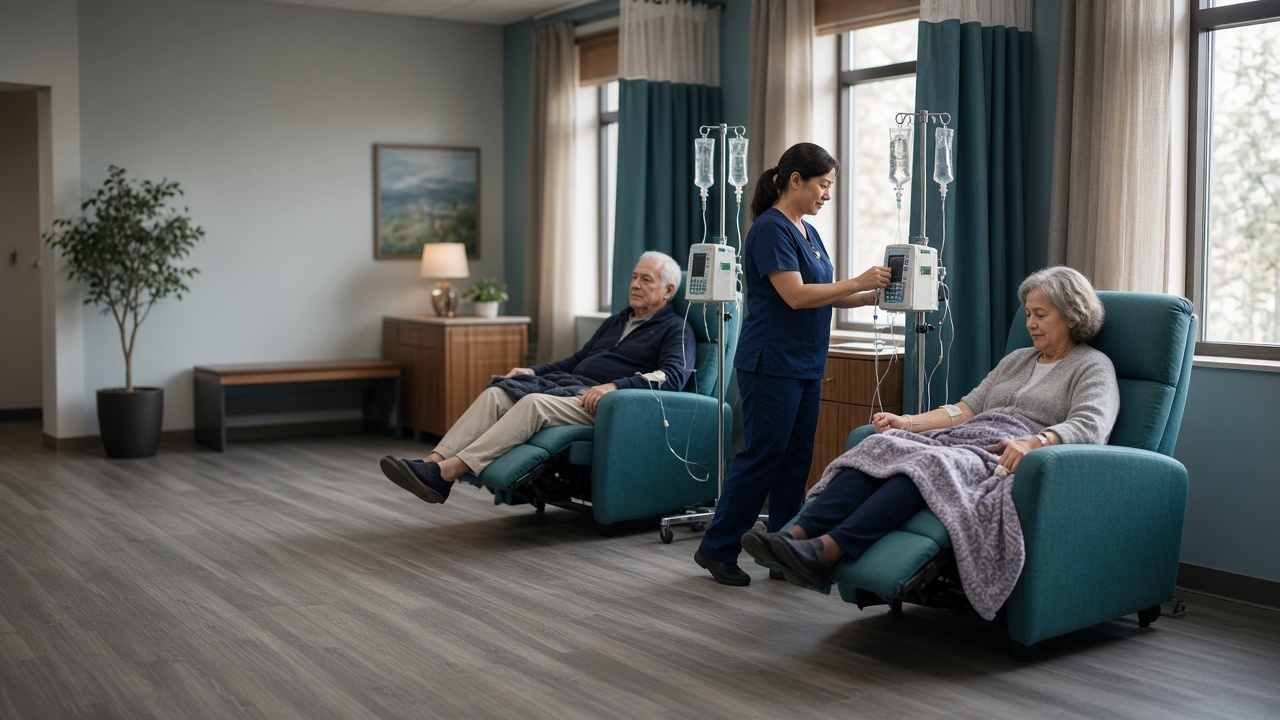
Photographs show the care setting. RSAI does not examine patients, prepare medication, read specimens, or perform surgery.
What makes infusion center revenue cycle management complex
Infusion center revenue cycle management ties a clinical calendar to a drug invoice. The same chair can deliver infliximab one hour and a different biologic the next. Each drug has its own unit, authorization, and administration family.
The revenue risk is concentrated. One denied drug line can be worth more than a week of evaluation-and-management visits.
Medication reimbursement
Buy-and-bill reimbursement depends on the payer’s allowed amount for the HCPCS code and on the units billed. The unit is defined by the code. J1745 is 10 mg of infliximab, excluding biosimilars. J3380 is 1 mg of intravenous vedolizumab. J2350 is 1 mg of ocrelizumab. Confirm the current CMS quarterly file before using any of those units.
RSAI does not calculate medication profitability and does not tell a center which drug to buy.
Authorization expiration
Infusion prior authorization is often a window, not a permanent yes. A dose scheduled after the end date, or a dose that exceeds the authorized amount, is a preventable denial.
Staff still read the payer’s letter. Automation tracks the dates. It does not negotiate the clinical policy.
Drug-unit calculations and administration coding
Units are dose divided by the code’s billing unit, under that payer’s rounding rules. A vial remainder is not automatically a billable unit.
Hydration (96360, 96361), therapeutic infusion (96365, 96366), sequential infusion (96367), concurrent infusion (96368), and chemotherapy administration (96413, 96415) answer different questions. Chemotherapy administration codes are not the default for every infused drug.
Drug wastage documentation
Medicare has discarded-drug reporting for separately payable single-use drugs, including the JW and JZ modifiers. Whether a remainder is payable depends on the drug, the package, and the payer.
Confirm the current CMS discarded-drug policy. RSAI does not decide wastage for the center. The documentation has to come from the administration record.
Denials, expected versus actual reimbursement, and forecasting
Infusion claim denials often cite authorization, medical necessity, units, or a bundled administration. An underpayment is a paid line that does not match the expected allowed amount. Comparing those figures is a review step. The numbers on this page are illustrative.
Payment forecasting concepts, such as a typical payer lag, are planning aids. RSAI does not claim an operational forecast that predicts a deposit date or an amount.
How AI-assisted automation supports the infusion workflow
The platform helps the center’s own team move eligibility, authorization tracking, coding assistance, claim edits, and status checks off a manual list. People still confirm the drug, the dose, and the appeal.
RSAI is not an outsourced billing company and it does not staff the infusion chair.
How RSAI differs from outsourced billing
An outsourced billing service takes the account and usually prices work as a percentage of collections. That percentage falls on drug collections as well as service collections.
RSAI is software the center’s team runs: a platform fee plus credits. The center keeps the payer contracts, the clinical record, and the decision to appeal.
Workflow
Treatment-to-Payment Workflow
Six stages from insurance verification to payment tracking. The clinical team administers the infusion. RSAI does not perform treatment.
1. Insurance verification
Operational challenge
The plan, the medical benefit, and the site of care have to be known before the drug is mixed.
Reimbursement risk
An inactive plan or a pharmacy-benefit drug billed as buy-and-bill is denied after the drug is already prepared.
StreamStatus follows claim status. StreamBill handles patient responsibility. A forecast of the payment date is a planning concept, not a live product promise.
Coding intelligence
Representative codes, not a chargemaster
Representative infusion CPT and HCPCS examples for coding review. Short categories only. CPT is a registered trademark of the American Medical Association. Confirm descriptors, units, modifiers, and payer rules for the date of service.
CPT examples
Swipe sideways to read every column.
CPT examples
Code
Category
What to confirm
96360
Initial intravenous hydration
Not a therapeutic infusion. Hydration has its own time rules.
96361
Additional hour of intravenous hydration
Requires the additional time. It is not an automatic add-on to every bag.
96365
Initial therapeutic intravenous infusion
The usual initial code for many non-chemotherapy drug infusions.
96366
Additional hour of therapeutic infusion
Depends on documented time past the initial hour.
96367
Sequential therapeutic intravenous infusion
A different drug, after the first infusion, up to one hour. Not a concurrent infusion.
96368
Concurrent intravenous infusion
A different drug running at the same time. Payers scrutinize this.
96413
Initial chemotherapy administration infusion
Only when the drug qualifies. Not a synonym for any biologic.
96415
Additional hour of chemotherapy administration
Same qualification as the initial chemotherapy code, plus time.
HCPCS examples
Swipe sideways to read every column.
HCPCS examples
Code
Category
What to confirm
J1745
Infliximab, biosimilars excluded, per 10 mg
Confirm the CMS HCPCS quarterly file. Biosimilars are reported with other codes.
J3380
Vedolizumab, intravenous, per 1 mg
Billing unit is 1 mg. Confirm the current file before calculating units.
J2350
Ocrelizumab, per 1 mg
Billing unit is 1 mg. Indication and payer policy are separate from the code existing.
These codes do not all apply to the same visit. Chemotherapy administration is not implied for every infused drug. Modifiers, including discarded-drug modifiers, apply only when the payer’s rule for that drug is met. Nothing here is a billing instruction for a specific patient.
The streams below are the ones most used for this specialty. They are part of the same eight. Stream Orchestrator is the coordination layer. It is not a ninth stream.