
When medications are expensive, percentage-based billing fees deserve a closer look
Revenue Stream AI helps rheumatology practices run eligibility, authorization, coding, claims, and follow-up on a platform fee plus credits — not a percentage of collections.
Large medication collections are not automatic profit
Medication collections help cover drug acquisition and other practice costs. When a billing agreement applies a percentage fee to those collections, that fee can materially affect the economics of providing treatment — especially for buy-and-bill biologics and other high-cost therapies.
This is a financial structure worth reviewing. It is not presented here as every rheumatologist’s single biggest concern or a ranked industry finding.
- Does the billing fee apply to medication collections? Confirm whether drug lines are in scope for the percentage.
- How is “net collections” defined? Definitions differ by agreement — refunds, adjustments, and carve-outs matter.
- Are drug and administration collections treated differently? Infusion admin and the drug itself are not the same revenue stream.
- What remains after acquisition cost and the fee? That remainder is not the same as practice profit.
- How much staff effort sits behind authorizations, denials, and follow-up? High-cost therapies often carry more administrative work per encounter.
Distinguish practice-purchased (buy-and-bill) medications from arrangements where the practice does not purchase or bill for the drug. Do not treat all medication reimbursement as profit.

Every Code Counts: Why Accurate Rheumatology Billing Protects Your Revenue
Rheumatology billing is some of the most complex in medicine. A single infusion visit can involve a high-cost biologic J-code, drug waste modifiers, administration CPT codes, and ICD-10 diagnoses that must support medical necessity. All of it depends on the patient’s coverage, prior authorization, and payer-specific rules. When one piece is wrong, the claim can fail and expensive drug revenue can be lost.
See moreSee less
Accurate CPT, ICD-10, and HCPCS Coding Is Essential
- CPT codes describe the service, such as infusion or injection administration, office visits, and joint injections.
- ICD-10 codes establish medical necessity. If the diagnosis doesn’t support the drug, the payer won’t cover it.
- HCPCS (J-codes) identify the drug and its billable units. Modifiers such as JW, JZ, JA, and JB report waste and route of administration.
Common issues:
- Wrong drug units or mismatched NDC-to-HCPCS conversions
- Missing or incorrect JW/JZ modifiers, which leave drug waste unpaid or trigger denials
- Diagnosis codes that don’t meet the payer’s coverage policy
- Under-coding administration services, or missing billable services altogether
- Coverage, authorization, or referral requirements that weren’t checked before treatment
Consequences:
- Denied or delayed claims and disrupted cash flow
- Write-offs on drugs that can cost thousands of dollars per dose
- Patient balances the patient didn’t expect, and lower patient satisfaction
- Staff time spent on appeals and rework
- Audit exposure, recoupments, and compliance risk
Eligibility and Coverage Come First
Clean claims start before the patient arrives. Confirming active insurance enrollment and verifying that the specific drug and procedure are covered under the patient’s plan prevents the most avoidable denials. Coverage changes often, especially at plan renewal, job changes, and Medicaid redeterminations. Verifying at every visit matters.
Authorizations and Referrals Protect Approved Care
Most rheumatology biologics require prior authorization, and many plans also require referrals. Treating without an approved authorization, or after one has expired, can mean the payer refuses to pay for the drug at all. Identifying requirements early, getting approvals on time, and tracking renewal dates keeps patients on schedule and keeps the practice paid.
The Revenue Difference: An Illustration
Example assumptions: a rheumatology practice with 200 infusion visits per month and an average reimbursement of $2,500 per infusion claim, or about $6,000,000 in expected annual revenue.
| Scenario | Coded and verified correctly | With errors |
|---|---|---|
| Expected annual revenue | $6,000,000 | $6,000,000 |
| Denials (10% of claims; 40% never recovered) | — | −$240,000 |
| Under-coding and missed drug waste (3%) | — | −$180,000 |
| No coverage, authorization, or referral write-offs (2%) | — | −$120,000 |
| Revenue collected | $6,000,000 | $5,460,000 |
| Revenue lost | $0 | $540,000 per year |
In this example, small errors add up to more than half a million dollars a year, before counting the staff cost of appeals and rework.
Revenue Stream AI: One Complete Cycle for Rheumatology Billing
Revenue Stream AI covers every stage of the revenue cycle, from intake to final payment:
- StreamDesk (Clean Intake): Captures accurate patient demographics and insurance details from the start.
- StreamVerify (Confirmed Coverage): Checks eligibility and confirms the drug and procedure are covered before treatment.
- StreamAuth (Approved Care): Identifies, obtains, and tracks prior authorizations and referrals.
- StreamCode (Captured Revenue): Licensed medical coders assign accurate ICD-10, CPT, and HCPCS codes and apply payer-specific modifier guidelines.
- StreamClaim (Payer Reimbursement): Prepares and submits clean claims, monitors insurance payments, and posts them accurately.
- StreamBill (Payment Collections): Handles patient collections and works denials to recover revenue that would otherwise be lost.
Revenue Stream AI: Clean intake. Confirmed coverage. Approved care. Captured revenue. Paid claims. A complete revenue cycle built for rheumatology.
Workflows we understand — services vary by practice
A scannable view of common rheumatology care. This is not an exhaustive universal list. Listing a service does not imply Revenue Stream AI supports its billing by default.
Procedures
- Joint aspiration / arthrocentesis
- Joint injections
- Bursa aspiration and injections
- Tendon sheath injections, including trigger finger and de Quervain’s procedures
- Carpal tunnel injections
- Ultrasound-guided injections and aspirations
Medication administration
- IV biologic and other prescribed infusion therapies
- Injectable medication administration
- Self-injection education
- Osteoporosis injections and infusions
Buy-and-bill economics apply when the practice purchases and bills for the drug. Arrangements where the practice does not purchase or bill the drug itself are different.
Diagnostic services
- Musculoskeletal ultrasound
- Bone-density testing where offered
- Joint-fluid analysis
- Laboratory testing and monitoring
Some diagnostics are delivered by clinical teams, laboratories, imaging services, or collaborating specialists.
Specialized services
- Nailfold capillaroscopy
- Salivary gland ultrasound
- Vascular ultrasound for selected vasculitis evaluations
- Synovial biopsy
- Minor salivary gland / lip biopsy
- Selected skin or muscle biopsies
- Trigger-point injections
Not universal. Listing a service here does not mean every practice offers it, or that Revenue Stream AI automates its billing by default.
Ongoing clinical care
- New-patient consultations and follow-up visits
- Rheumatoid arthritis and psoriatic arthritis management
- Axial spondyloarthritis care
- Lupus and other connective tissue disease management
- Gout management
- Vasculitis care
- Osteoporosis management
- Medication safety monitoring


Shown: hand/joint consultation and ultrasound-guided knee injection. Services vary by practice; some diagnostics and specialized tests are delivered by labs, imaging partners, or collaborating specialists.
How Revenue Stream AI can support the work
Each item below is limited to published Stream module capabilities. Outcomes depend on practice circumstances — we use “can help,” not guarantees.
StreamVerify™
Eligibility checks before high-cost therapy days — so plan changes surface before an infusion is prepared.
Can help reduce write-offs tied to coverage gaps on expensive medication encounters.
Product detailsStreamAuth™
Prior authorization assembly, submission, and tracking for services that need approval — including infusion-related workflows called out on the product page.
Can help shorten the lag between clinical decision and authorized treatment.
Product detailsStreamCode™
AI coding recommendations for ICD-10-CM, CPT/HCPCS, modifiers, and E/M — with a human coder in the loop. Does not auto-submit codes.
Can help catch specialty detail on visits, procedures, and administration lines before the claim leaves.
Product detailsStreamClaim™
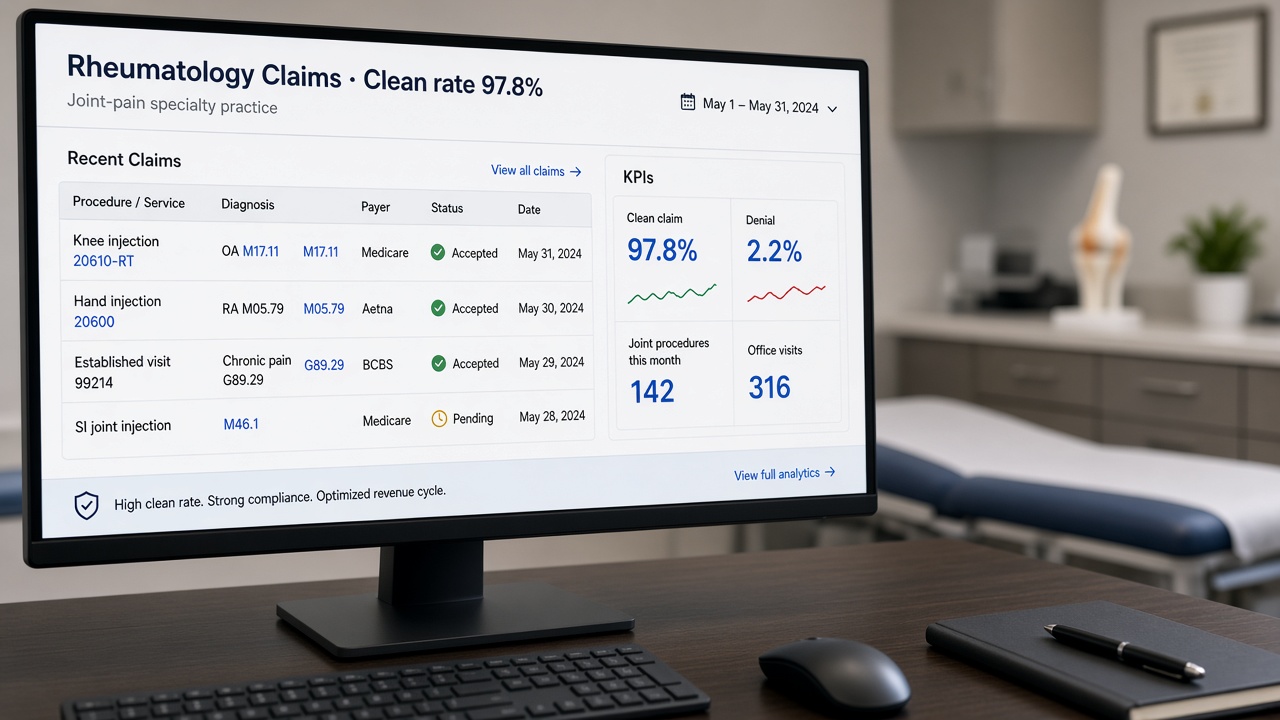
Claim edits, payer submission, ERA posting, and AI-assisted denial appeals — published 97.8% clean-claim target.
Can help keep high-dollar medication and administration lines from aging in rework.
Product detailsStreamStatus™
Automated claim-status checks that surface pended and denied claims when status changes.
Can help staff spend less time on portal look-ups for in-flight drug and visit claims.
Product detailsStreamBill™
Patient estimates, statements, and collections workflows — complementary to payer-side medication billing.
Can help clarify patient responsibility without treating drug reimbursement as practice profit.
Product details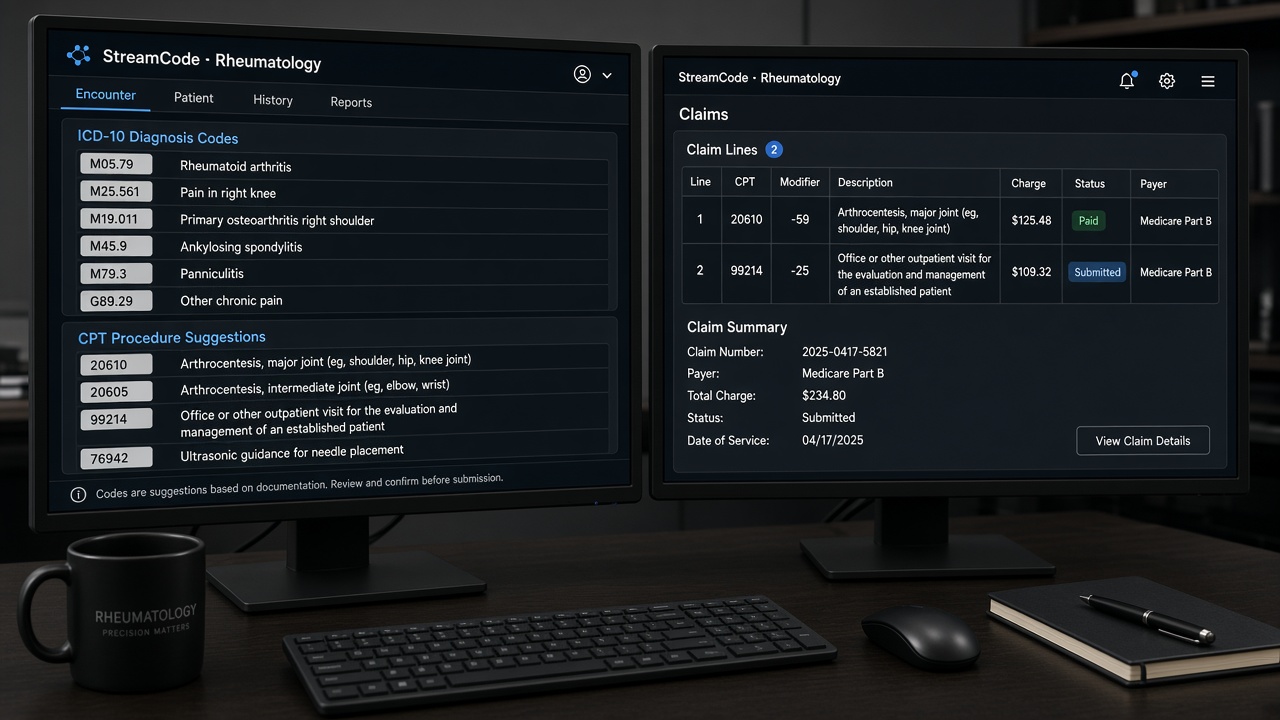

Sources: product pages for StreamVerify, StreamAuth, StreamCode, StreamClaim, StreamStatus, and StreamBill. CMS discarded-drug (JW/JZ) rules: CMS JW / JZ modifiers.
Estimate a percentage fee on medication collections
Hypothetical inputs only. This calculates a billing fee on collections you mark as subject to that fee. It does not compute Revenue Stream AI savings or practice profit.
Your hypothetical terms
Enter figures from your agreement and recent buy-and-bill volume. All fields are illustrative.
Included in the fee math: only the collections and percentage you enter. Excluded: RSAI pricing, staffing, overhead, payer mix, and any collections not subject to the fee.
Published Revenue Stream AI pricing shape
From the Pricing page — not a custom quote and not a savings guarantee.
- No percentage of your revenue — platform fee + Automation Credits
- Practice Essentials $1,495/mo · Growth Suite $2,495/mo · Enterprise $4,995/mo
- Shared credit pool across Streams (Verify, Auth, Code, Claim, Status, Bill, Desk)
- Industry frame on Pricing: percentage-based billing often cited at 4–10% of collections — confirm your own contract
We do not subtract an RSAI fee from the illustration above or claim a dollar savings until your volume, module mix, and comparable service scope are confirmed. Revenue Stream AI Pricing.
View pricingStraight answers
Does Revenue Stream AI charge a percentage of collections?
Does a percentage billing fee always apply to medication collections?
Is medication reimbursement the same as profit?
What clean claim rate does Revenue Stream AI publish?
Does listing a rheumatology service mean Revenue Stream AI supports its billing?
Industry denial pressure for context: ~15% private-payer claims initially denied (Premier Inc., March 21, 2024 (516 hospitals, 36 states; CY2022 claims)); 41% of providers report denial rates of 10%+ (Experian Health, State of Claims 2025 (survey of 250 finance/billing/claims leaders, June–July 2025; published Sept 2025)). Clean-claim target: StreamClaim™ published target (97.8% clean claim; industry comparison ~85%).
Review your medication billing economics with our team
Bring your agreement terms and recent buy-and-bill volume. We’ll map verified Stream capabilities to your workflows — without inventing savings figures.